
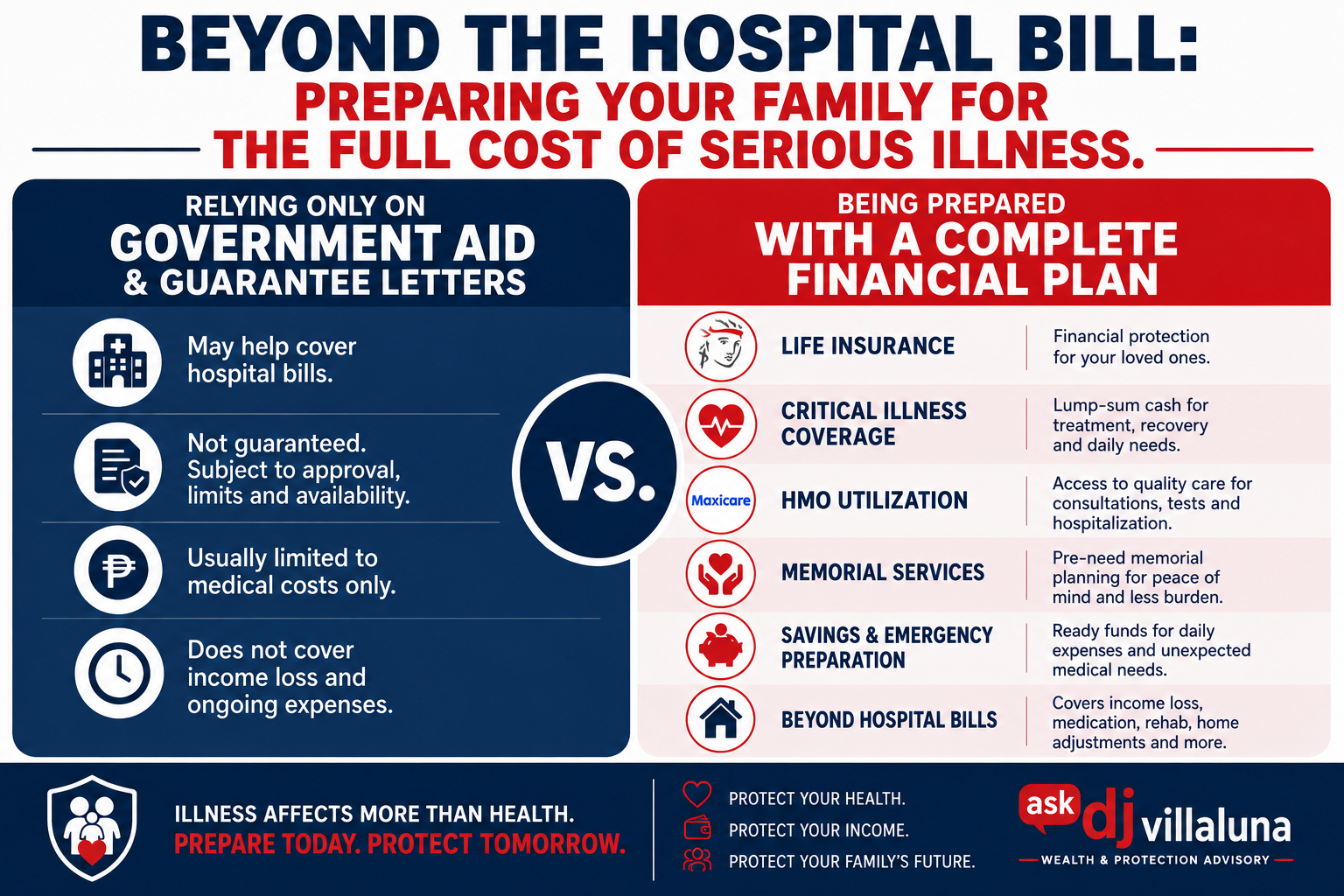
A Guarantee Letter May Help with the Hospital Bill—but What Happens After You Go Home?
When a serious illness happens, many Filipino families immediately look for every possible source of help.
They approach government offices, charitable institutions, party-list representatives, local officials, and politicians to request medical assistance or a guarantee letter. These forms of support can provide meaningful relief, especially when hospital bills are already beyond the family’s available funds.
There is nothing wrong with asking for help during an emergency.
However, government assistance and guarantee letters should ideally serve as additional support—not as the family’s entire financial plan.
An Illness Does Not End at the Hospital
When we think about a medical emergency, we usually focus on the hospital bill. But hospitalization is often only the beginning of the family’s financial burden.
After the patient is discharged, the family may still need to pay for:
- Maintenance medicines and medical supplies
- Laboratory tests and follow-up consultations
- Physical therapy, rehabilitation, or home nursing care
- Special food and transportation
- Medical equipment such as wheelchairs, hospital beds, or oxygen
- Changes to the home for safer movement and accessibility
- Daily household expenses while the patient or caregiver cannot work
The family’s income may decrease at the same time that its expenses increase.
The patient may need several weeks or months to recover. A spouse, parent, or adult child may also have to stop working temporarily to become the primary caregiver.
A hospital bill may eventually be paid, but electricity, rent, food, tuition, loan payments, and other household expenses will continue.
This is why medical preparation must go beyond finding someone who can help settle part of the hospital account.
Different Resources Have Different Purposes
No single financial product or assistance program can solve every problem. A stronger emergency plan uses several layers of protection.
HMO coverage can help with eligible consultations, diagnostic procedures, emergency care, and hospitalization, subject to the plan’s limits, exclusions, and accredited providers.
Critical illness insurance can provide a lump-sum cash benefit when the insured is diagnosed with a covered condition and meets the policy requirements. Unlike a benefit paid directly to a hospital, this money may be used according to the family’s priorities—such as replacing lost income, buying medicines, paying for rehabilitation, or modifying the home.
Life insurance can protect the family financially if the breadwinner does not survive the illness. It can help replace income, settle obligations, and provide funds for the family’s continuing needs.
Emergency savings give the family readily available cash for expenses that may not be covered by insurance, an HMO, or government assistance.
Pre-need memorial services, such as St. Peter plans, can help families prepare for funeral-related services in advance. This may reduce the number of urgent decisions and expenses that loved ones must handle during an already difficult time. The exact inclusions and conditions should always be reviewed before purchasing.
Government medical assistance and guarantee letters may help reduce eligible medical costs, but their availability, processing requirements, coverage, and approval are not always guaranteed. They may also be limited to specific hospital charges and may not address lost income or long-term recovery expenses.
Each resource has a role. The goal is not to choose only one, but to understand how they can work together.
Preparation Is Not About Expecting the Worst
Preparing for illness does not mean living in fear.
It means recognizing that emergencies can affect more than a person’s health. They can also affect the family’s income, savings, home, work, and future plans.
Not every family can prepare everything immediately. Some may begin with a small emergency fund. Others may secure an HMO through their employer, purchase personal health coverage, prepare memorial services, or obtain critical illness and life insurance.
What matters is starting with what you can afford and gradually closing the most serious financial gaps.
Government assistance can remain an important safety net. But whenever possible, families should also build resources that are already in place before an emergency happens.
Because during a serious illness, the question is not only:
“Who will pay the hospital bill?”
The family must also ask:
“How will we continue living, recovering, and paying our daily expenses after we leave the hospital?”
A complete financial protection plan cannot prevent illness. But it can give a family more choices, more time to recover, and less dependence on assistance that may not cover everything.
Use the Financial Protection Assessment Tool to identify possible gaps in your current preparation, or schedule a free consultation to discuss which areas you may need to prioritize.
Insurance, HMO, pre-need, savings, and government assistance have different terms, limitations, and purposes. Always review the official contract, benefit limits, exclusions, and eligibility requirements before making a financial decision.