When PhilHealth Is Not Enough: Why Every Filipino Family Needs a Backup Plan
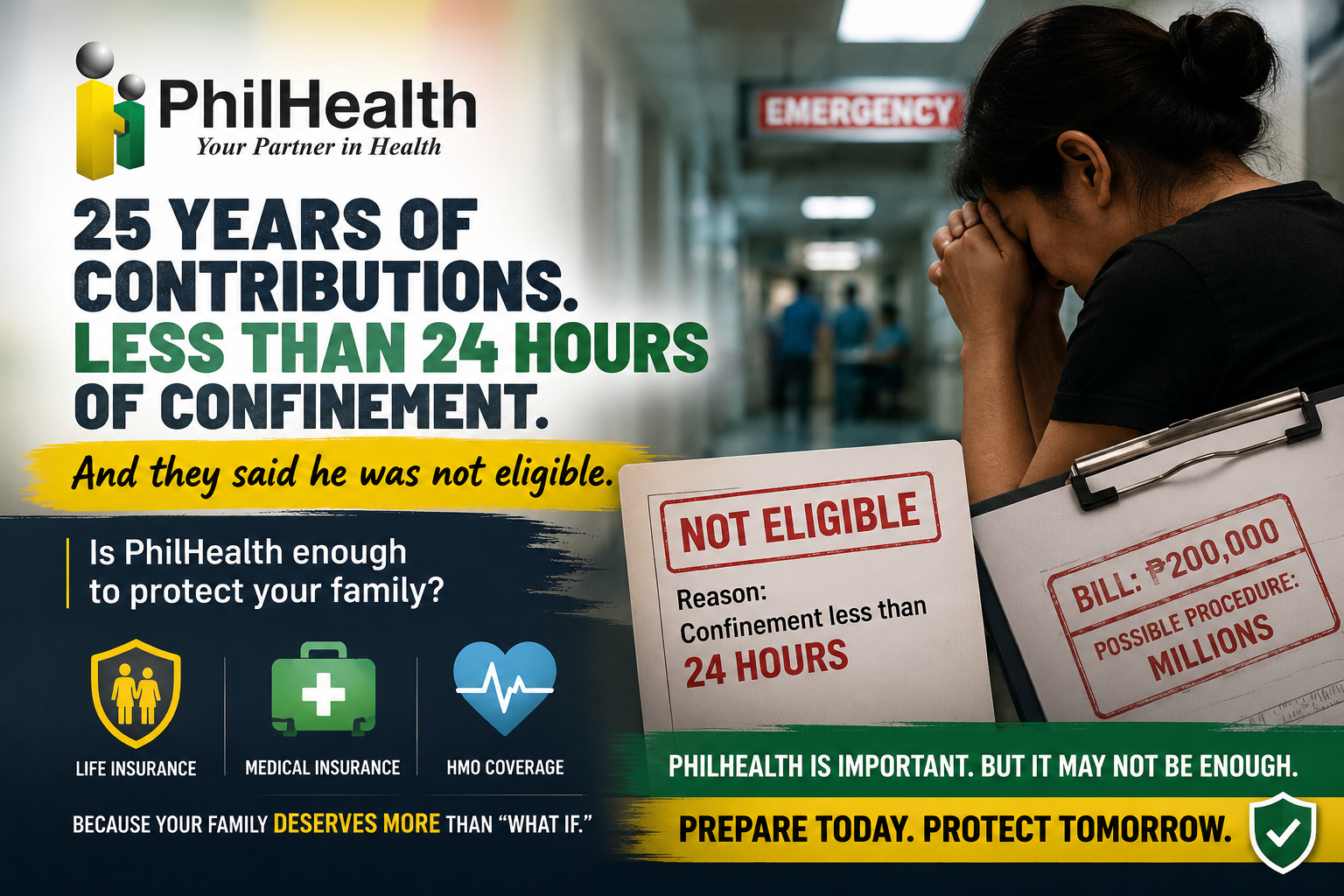
I have been thinking about the story of the widow whose husband reportedly contributed to PhilHealth for more than 25 years.
Twenty-five years.
That is longer than some careers.
Longer than some businesses survive.
Longer than many people stay committed to one financial responsibility.
For 25 years, every contribution meant trust.
Trust that when sickness comes, help will be there.
Trust that when hospital bills rise, there will be support.
Trust that when the worst day of a family’s life arrives, the system they paid into will somehow carry part of the burden.
But according to reports, when her husband needed urgent help, the hospital bill reached almost ₱200,000, and a life-saving procedure could have cost millions.
Then he died.
And after that, the widow reportedly learned that he was not eligible for PhilHealth benefits because his confinement lasted less than 24 hours.
Less than 24 hours.
Imagine hearing that while grieving.
Imagine explaining that to your children.
Imagine spending decades contributing, only to discover that on the worst day of your life, the fine print matters.
This story is not mine. It is a public story that many Filipinos reacted to because it touched something real.
It reminded us of one painful truth:
Government benefits help, but they are not always enough.
PhilHealth is important. SSS is important. Government support matters. But families should not depend on only one source of help when sickness, accident, disability, or death happens.
Because when a medical emergency comes, the bill does not wait.
The hospital does not ask if you are emotionally ready.
The doctor does not pause the diagnosis because your family still needs time to raise money.
The disease does not care if your savings are not yet complete.
And this is where many Filipino families become vulnerable.
They have PhilHealth, but no HMO.
They have savings, but not enough for a major illness.
They have income, but no income replacement.
They have love for their family, but no prepared financial protection.
That is why life insurance, medical insurance, and HMO are not just “extra expenses.”
They are layers of protection.
PhilHealth Is a Foundation, Not the Whole House
PhilHealth can reduce medical costs, but it does not guarantee that every hospital bill will be fully covered.
For many families, PhilHealth is helpful, but it may only be one part of the solution.
A family still needs to prepare for:
Emergency room expenses
Doctor’s fees
Medicines
Room charges
Diagnostics
Surgery costs
Critical illness costs
Lost income
Recovery expenses
Funeral expenses
Family living expenses after the breadwinner is gone
This is why depending only on one benefit can be dangerous.
Not because PhilHealth is useless.
But because one layer of protection is rarely enough when the emergency is big.
HMO Helps While You Are Alive and Seeking Treatment
An HMO can help with consultations, checkups, laboratories, emergency care, and hospitalization depending on the plan.
This matters because many illnesses become worse when people delay treatment due to fear of expenses.
A good HMO can help a person seek medical attention earlier.
It can help a family avoid paying everything out of pocket.
It can make healthcare feel more accessible before the situation becomes critical.
Medical Insurance Helps With Bigger Hospital Bills
Medical insurance is different from a basic HMO.
It is usually designed for larger medical expenses, major hospitalization, and serious health events depending on the policy.
If the bill reaches hundreds of thousands or even millions, this is where bigger medical coverage can matter.
Because the truth is simple:
A small sickness may be handled by savings.
A moderate sickness may be helped by an HMO.
But a major illness can destroy years of income if the family is not prepared.
Life Insurance Protects the Family After Death
This is the part many people avoid talking about.
But we have to.
When the breadwinner dies, the income usually dies with him.
The bills do not.
Rent continues.
Food expenses continue.
Tuition continues.
Debt continues.
Daily survival continues.
Life insurance is not for the person who dies.
It is for the people who are left behind.
It gives the family money at the exact time they are emotionally broken and financially vulnerable.
It can help pay for final expenses, debts, children’s education, daily needs, and the adjustment period after losing a provider.
The Real Question Is Not “Do I Have PhilHealth?”
The real question is:
If something happens to me today, what will my family actually receive?
Not what I hope they will receive.
Not what I assume they will receive.
Not what I heard from other people.
But what is actually written, approved, and prepared?
How much HMO coverage do I have?
How much medical insurance do I have?
How much life insurance do I have?
How much emergency fund do I have?
How long can my family survive without my income?
These are uncomfortable questions.
But they are better answered while we are healthy, working, and still insurable.
Because when the emergency comes, options become limited.
Do Not Wait for a Tragedy Before You Build a Plan
Many Filipinos are not careless.
They are just busy surviving.
They work, pay bills, support family, send children to school, help parents, pay loans, and try to save whatever is left.
But protection should not be something we only think about after a tragedy.
It should be part of responsible financial planning.
Not because we are expecting the worst every day.
But because we love people who will suffer if we are not prepared.
If you are a breadwinner, parent, spouse, OFW, employee, business owner, freelancer, or professional, you need to know your protection gap.
Your protection gap is the difference between:
What your family will need if something happens, and
What your current benefits, savings, and insurance can actually provide.
That gap can either be planned for now or discovered during an emergency.
And discovering it during an emergency is usually painful.
Start With an Assessment
You do not need to buy immediately.
But you need to know where you stand.
Do you already have enough protection?
Is your HMO enough?
Is your life insurance enough?
Do you have medical coverage for major illness?
Will your family have money if your income stops?
Are you relying too much on government benefits alone?
I created an assessment tool to help you understand your current situation and what type of protection may fit your needs.
It is not about forcing you to get a plan.
It is about helping you see the truth before life forces you to see it.
Because one day, it may not be about whether you contributed for 25 years.
It may be about whether your family has enough money when they need it most.
PhilHealth matters. Government benefits matter.
But your family deserves more than one layer of protection.
Take the assessment today and find out what protection you may still need.
Leave a Reply