
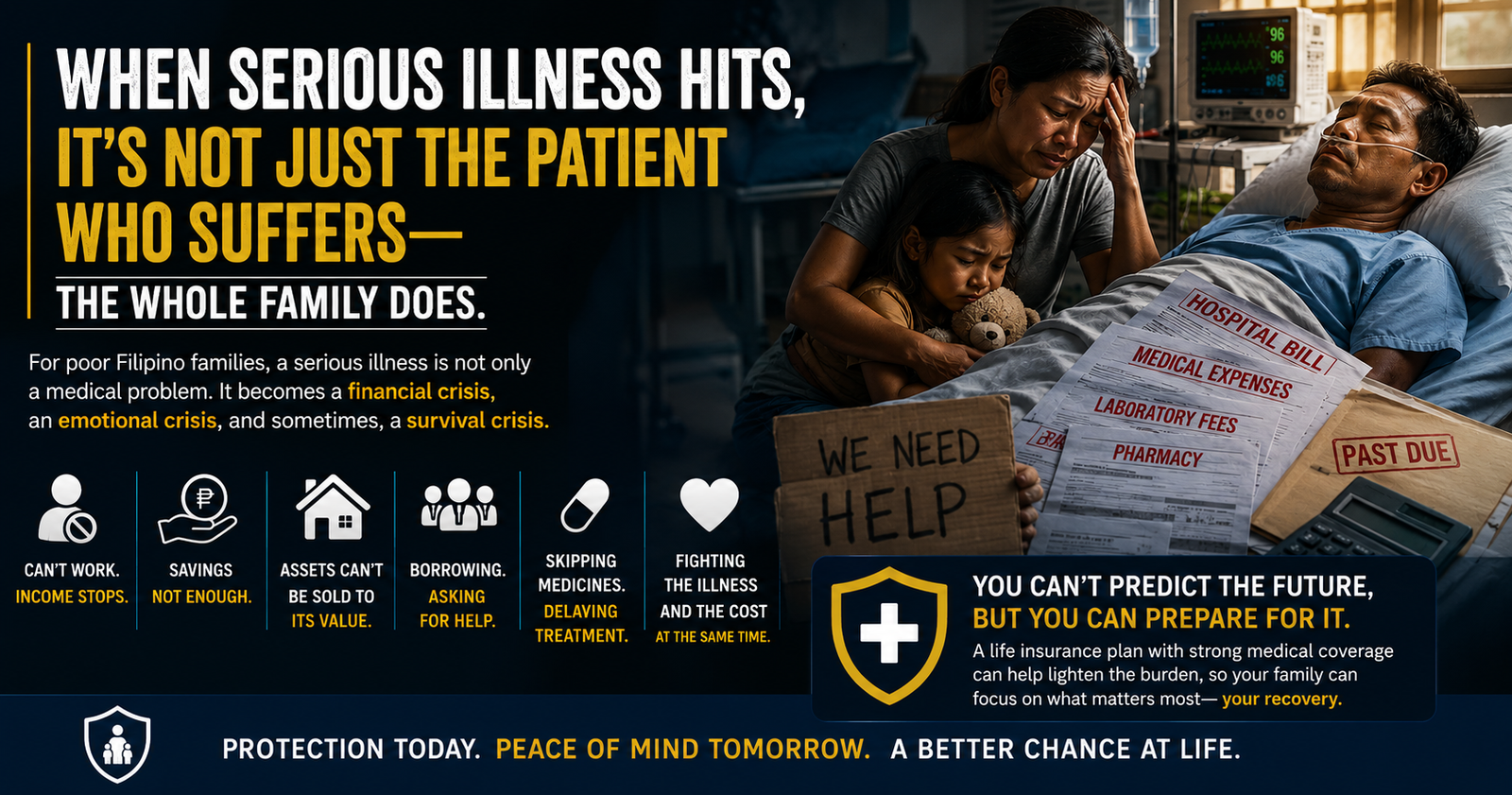
When Serious Illness Hits a Poor Filipino Family
When a rich Filipino gets diagnosed with a serious illness, the situation is painful—but many times, they still have options.
They may have savings.
They may have premium medical insurance.
They may have assets they can use, sell, or borrow against.
They may have access to better hospitals, specialists, private rooms, and faster treatment.
When a middle-class Filipino gets diagnosed with a serious illness, the situation becomes much heavier.
The family may still fight—but the price of survival can be painful. Savings can disappear. Emergency funds can be drained. Properties, vehicles, or small investments may be sold. Sometimes, assets are sold below their true value because the family needs cash immediately.
But what happens when a poor Filipino family faces the same serious illness?
That is where the situation can become heartbreaking.
For many poor Filipino families, a serious illness is not only a medical problem. It becomes a financial crisis, an emotional crisis, and sometimes a survival crisis for the whole household.
The patient may not be able to work. The family’s income may stop or become smaller. Daily expenses continue—food, rent, electricity, transportation, school needs, and medicines. At the same time, hospital bills, laboratory tests, doctor’s fees, treatment costs, and maintenance medicines begin to pile up.
In the Philippines, household out-of-pocket payments still make up a large part of health spending. The Philippine Statistics Authority reported that household out-of-pocket payments accounted for 41.2% of current health expenditure in 2025. The World Bank also shows that out-of-pocket spending in the Philippines was still high at 44.36% of current health expenditure in 2023.
This means many Filipino families still pay a big portion of medical costs using their own money.
For a poor family, where will that money come from?
They may borrow from relatives.
They may ask help from friends.
They may go to government offices.
They may start online donation drives.
They may delay treatment while looking for funds.
They may skip medicines because the budget is not enough.
They may choose cheaper options, even when the doctor recommends something better.
A 2025 study on Filipino households with noncommunicable diseases found that many families cope with healthcare expenses by seeking cheaper treatment, borrowing money, or relying on savings. But for poor families, savings may not even exist in the first place.
And that is the painful reality.
The poor do not only fight the illness. They fight the cost of the illness.
They fight the fear of being confined.
They fight the pressure of every hospital bill.
They fight the shame of asking for help.
They fight the guilt of becoming a burden.
They fight the possibility of stopping treatment not because they want to, but because they cannot afford to continue.
In a hard economy, everything is already expensive. Food is expensive. Rent is expensive. Electricity is expensive. Education is expensive. Transportation is expensive.
But one of the most expensive things that can happen to a Filipino family is a serious illness.
Because when serious illness comes, expenses increase while income can decrease.
The patient may stop working.
The caregiver may also stop working.
Savings may not be enough.
Assets may be difficult to sell.
And even if assets can be sold, they may be sold at a bargain price because the family needs money urgently.
This is why financial protection matters.
Life insurance with strong medical coverage is not a magic solution. It cannot prevent sickness. It cannot promise that everything will be easy. It cannot remove the emotional pain of a diagnosis.
But it can help lighten the burden.
A properly planned life insurance policy with heavy medical coverage can provide money when a serious illness happens. It can help cover treatment costs, hospital expenses, critical illness needs, recovery costs, and even income loss depending on the benefits included in the plan.
Most importantly, it can give the family breathing room.
Instead of focusing only on where to borrow money, the family can focus more on treatment.
Instead of selling assets in panic, they may have financial support.
Instead of stopping medication too early, they may have a better chance to continue.
Instead of carrying the entire burden alone, they have a plan that helps them stand again.
We can never fully know the future. No one can predict who will get sick, when it will happen, or how much it will cost.
But we can prepare.
Because when life is healthy, we still have choices.
When illness comes, choices become fewer.
For rich families, illness may reduce wealth.
For middle-class families, illness may wipe out years of progress.
For poor families, illness may threaten survival itself.
That is why protection should not be treated as an extra expense only for people with a lot of money. Protection is often more important for families who have less room for error.
The goal is not to scare people.
The goal is to help families prepare before the crisis happens.
Because when serious illness comes, the question is not only:
“Will I survive?”
The question also becomes:
“Will my family survive financially while I recover?”
A life insurance plan with strong medical coverage may not solve everything.
But it can help give you and your family one powerful thing during one of the hardest moments of life:
A chance to focus on healing, recovery, and getting back on your feet.